

Healthcare organizations don't get the luxury of a slow transition. Between regulatory requirements, operational complexity, and the volume of data flowing through clinical, financial, and administrative systems, analytics infrastructure needs to work; constantly, accurately, and at scale.
So when a major academic medical center came to us with a sprawling Tableau environment, a looming license renewal, and no clear picture of what a migration would actually cost, the first job wasn't to start moving workbooks. It was to answer a more foundational question: what do you actually have, and what's worth keeping?
The Situation: Size, Uncertainty, and a Decision That Needed to Be Defensible
The organization was running an on-premises Tableau estate serving roughly 4,000 users across 500 workbooks. The challenge wasn't just scale — it was that years of organic growth had left the portfolio full of redundant and unused content. No one could say with confidence what a migration would take, what it would cost, or which workbooks actually mattered.
At the same time, their early Fabric environment wasn't ready to receive anything. A single proof-of-concept dashboard, default tenant settings, and outdated gateway infrastructure meant the platform needed to be built before any content could land, and that work needed to happen in parallel, not after.
With a Tableau renewal on the horizon, the pressure to make a defensible decision was real.
Phase One: Rationalize First, Migrate Second
We started with rationalization. Using Vortex®, we harvested the full Tableau metadata and scored every workbook for complexity and usage. This is the step that changes everything; instead of approaching migration as a brute-force effort against hundreds of workbooks, you walk in knowing exactly what you have.
The result: the portfolio was reduced to 145 real migration candidates, retiring more than two-thirds of the estate before a single workbook moved. That alone materially changes the scope, cost, and risk profile of everything that comes next.
Alongside rationalization, we ran a Vortex proof of value — converting two representative workbooks to Power BI to validate the automated approach and test our effort estimates before the organization committed to a full migration. The estimates held, giving leadership a concrete, evidence-based case for moving forward.
Phase Two: Build the Foundation Before Content Lands
In parallel, we delivered Fabric Foundations — standing up the production platform the organization will need to actually receive migrated content at scale.
This included gateway infrastructure, workspace provisioning, security configuration, and a governed data environment built to enterprise standards. Alongside the technical build, we delivered a full set of enablement materials — guides, templates, and references — designed so the client team can operate and sustain the platform independently, without ongoing dependency on us.
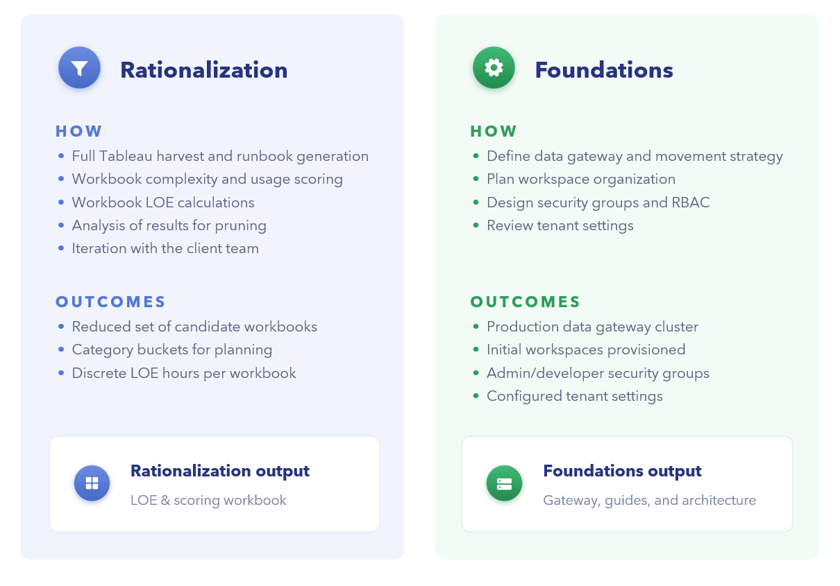 The organization moved from a single-dashboard proof of concept to a production-ready Fabric environment.
Why the Order Matters
The instinct in a lot of migrations is to start moving content as quickly as possible; especially when a license deadline is adding pressure. What we've seen is that skipping rationalization and foundation work doesn't save time. It creates risk: migrating workbooks no one uses, landing content on a platform that isn't ready, and arriving at a cost estimate only after the work is underway.
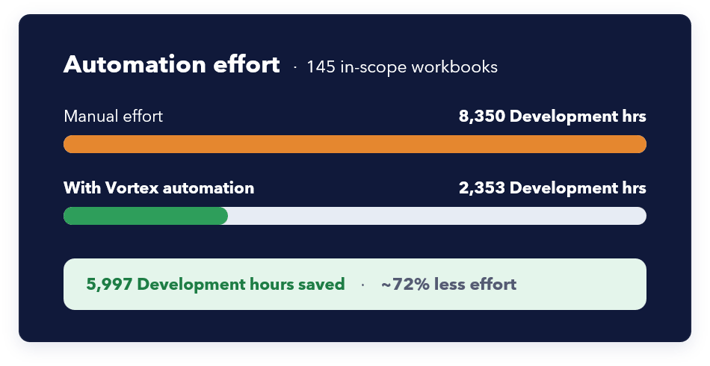
Doing it in the right order: rationalize, prove the approach, build the foundation — means the actual migration phase starts from a position of confidence rather than uncertainty. For this organization, Vortex automation is projected to reduce development effort on the 145 in-scope workbooks by 72%. That number is credible because we validated it before committing to it.
What Comes Next
The rationalization and foundations work is complete. The organization now has a clear migration scope, a validated automation approach, and a production Fabric platform ready to receive content. The migration itself is the next chapter, and it starts from a much stronger position than it would have without this groundwork.
That's the right way to approach a migration of this size. And it's replicable for any health system facing the same situation.
If your organization is trying to understand what a Tableau to Fabric migration would actually take — before committing to one — Vortex rationalization is the right place to start. We'd be happy to walk you through what that looks like.