

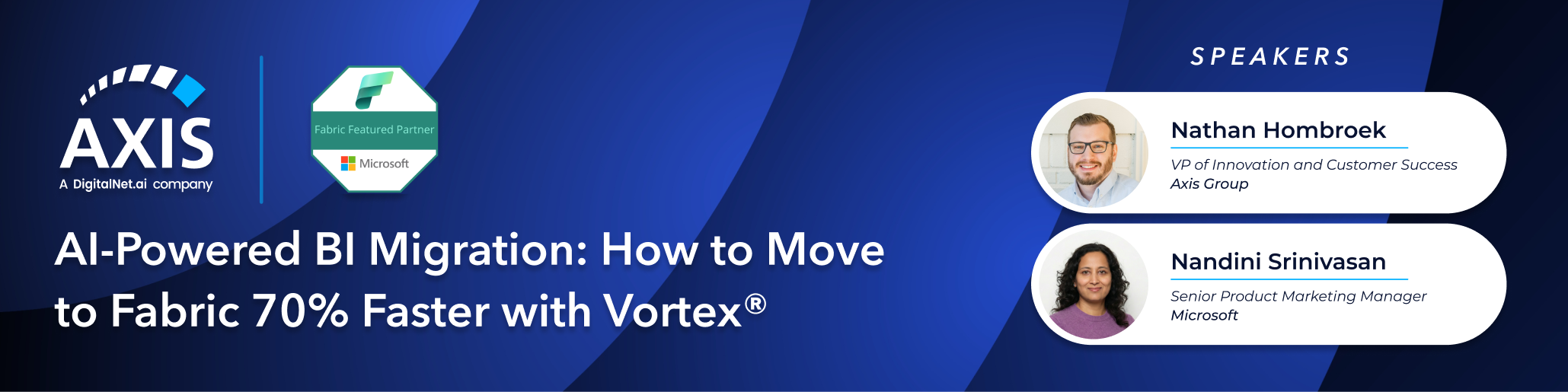
Axis recently hosted a live webinar alongside Microsoft to tackle one of the most common questions we hear from data and analytics leaders: When is the right time to move to Microsoft Fabric—and how do you actually get there?
Nathan Hombroek, our VP of Innovation, led the session alongside Nandini Srinivasan, Senior Product Marketing Manager on the Microsoft Fabric team, and Chris Gschwind, Senior Engineer on our Vortex platform. Together, they covered the state of the Fabric ecosystem, why the window to act is now, and what a faster, smarter migration actually looks like.
The Data Foundation Problem No One Talks About Enough
Nandini opened with a framing that resonated throughout the entire session: AI is only as good as the data behind it.
"If the data is inconsistent or it's fragmented, AI will only exacerbate that problem. The fastest path to better AI outcomes is a stronger, more accessible, and governed data foundation."
That's the core tension most organizations are sitting in right now. There's real enthusiasm for AI — but the underlying data estate isn't ready to support it. Point solutions, siloed systems, and patchwork integrations have created complexity that slows teams down and puts the burden squarely on IT.
Microsoft Fabric was built as the answer to that problem: a unified platform spanning data integration, engineering, warehousing, real-time intelligence, and Power BI — all grounded on OneLake and infused with Copilot across every workload.
The momentum is real. Nandini shared that Fabric now has over 31,000 customers on the platform, with 60% year-over-year growth — a number Satya Nadella recently called out on earnings as the fastest-growing analytics platform at Microsoft.
The BI Migration Problem That's Holding Organizations Back
Even organizations that are ready for Fabric face a serious obstacle: getting their existing BI environment there. Nathan laid it out plainly:
"The old way of doing this—manual migration—is essentially designed to fail. Over four out of five projects either fail or stall before they're completed, typically taking at least a year, sometimes up to three or more."
The culprit isn't just effort, it's scope. Environments built up over years (or decades) accumulate redundant assets, duplicated reports, and layers of business logic that are invisible until you start digging. Cost overruns of 3x–4x original estimates are common when teams tackle this manually.
A Better Way: Vortex
Vortex is Axis Group's AI-powered migration solution, built specifically to solve this problem. Rather than replacing human expertise, it automates the heavy lifting so engineers can focus on work that actually requires judgment.
The process runs in three phases:
Rationalization: Vortex harvests all metadata from your legacy environment, analyzes usage logs, and surfaces what actually needs to be migrated. Nathan noted that they typically find 50–80% of an environment is either unused or duplicated — scope that can be eliminated before a single line of code gets converted.
Conversion: Using a combination of deterministic logic and a custom-trained AI model, Vortex converts front-end reports, DAX measures, and back-end ETL logic into Power BI and Microsoft Fabric-ready assets. Output SQL can be deployed to any warehouse of choice.
Last Mile Development : Automated outputs are handed off to engineers for final refinement, testing, and production deployment. Axis can run this entirely or work alongside a client's own team.
The result: migration timelines measured in weeks, not years, with up to 70–80% reduction in developer hours compared to a manual approach.
The Cost of Waiting
The session closed with a direct challenge from Nathan:
"While the cost of waiting compounds, if your competitors are getting on to this consolidated, effective ecosystem to gain all these new features that are rolling out, you risk getting further behind and racking up more of that legacy cost and tech debt."
The migration is a starting point, not the destination. Once organizations are on Fabric, they unlock Copilot, OneLake integration, real-time intelligence, and a governed data estate that positions them to move faster on AI, not slower.
Watch the Full Webinar
If you missed the live session, the full recording is available above. It includes a live demo of Vortex walking through a real Qlik environment—from metadata harvest through rationalization, conversion, and final Power BI output.
Ready to see what this looks like for your environment? Request a free strategy session →